News Library

Coming out of COVID-19 – starting your building projects

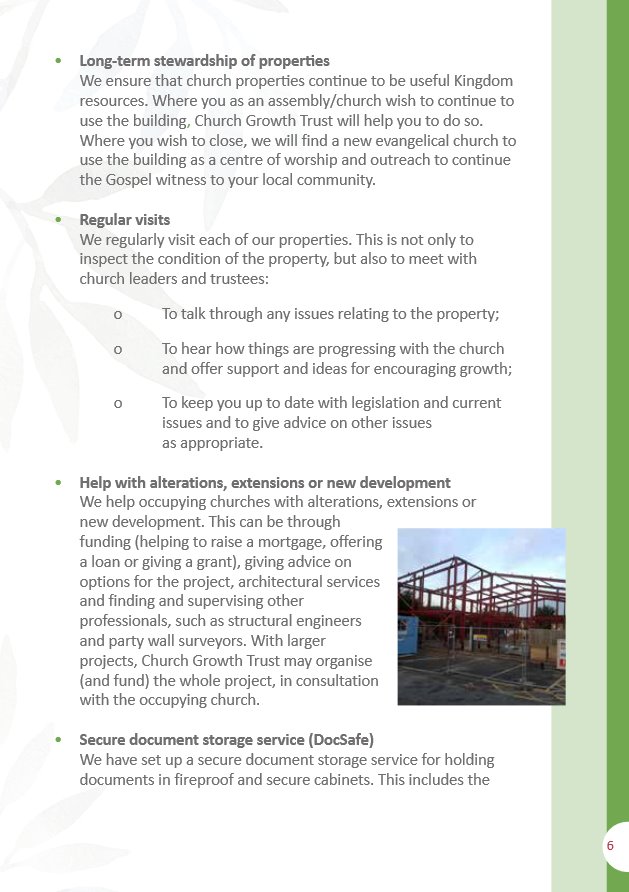
From 13 May 2020 in England the government advised workers who cannot work from home that they may travel to work if their workplace is open. This means that building sites can now be open for work and therefore church building projects are restarting. There are two aspects to this that you need to consider. The first relates to your church employees and volunteers, and the second to the contractors, delivery people and others visiting your site.

If you as a church have employees and volunteers you should be taking responsibility for them and ensuring that their activities are risk assessed. You may already have risk assessments. These should be updated in light of the current additional risks with COVID-19. As well as carrying out risk assessments, you should also discuss with your employees and volunteers the risks and actions you are taking (or proposing to take). You also have a duty of care to contractors that are working on your property. This should include not asking them to carry out anything that would put them at risk.

Under the CDM regulations, where building work is taking place, you as the client are considered to be the “principal designer”, unless you have formally (in writing) delegated this responsibility to someone else (e.g. your architect). The principal designer is responsible for ensuring that the building is designed and constructed and can be subsequently used and maintained in safety. The risks to health and safety not only affect the construction workers themselves, but also members of the public who may be in close vicinity during building works, and those who may continue to use a building during alterations or extensions.

Contractors are responsible for their employees and subcontractors and have a duty of care to you to ensure they are not putting you or your employees, volunteers or visitors at risk. They should be carrying out risk assessments on the work methods they are using and should ensure that all workers comply with the agreed protocols.

It is key that you and your contractors agree on who is taking responsibility for different services and facilities on site and who is responsible for setting out procedures and enforcing safety measures on different parts of the site and project. This is normally set out in writing and can be included in the contract for the construction project.

You will need to risk assess the following:

·         Travel to and from work, as well as driving at work

·         Site access and exits

·         Meetings

·         Facilities on site including hand washing, keeping your workplace clean, toilets, rest areas and other communal areas, and first aid, emergency service response, accidents and security.

·         Working on site, including social distancing, planning work to avoid close working and additional precautions where social distancing is not possible.

We have produced a briefing paper, which gives more details of the government guideline. It will help you think through the issues that you have to risk assess and how you are to practically work with contractors, staff and volunteers on your building project.

Be Encouraged – June 2020

Being people of hope in Jesus, hearing good news in this current season encourages our faith in God, who is not shaken by this pandemic but moving in our nation.

We are also encouraged with the Media featuring positive articles, and even joking comments which may be true, relating to the Christian faith and Church, as we are adapting to not being able to meet physically, alongside evidence of an unprecedented surge in internet searches for prayer and people attending online church services.

Google searches on prayer skyrocketed during the month of March 2020 when the COVID-19 went global.  The 24-7 Prayer network has seen a massive increase in prayer rooms it supports from 260 in March 2019 to 600 (covering 40 nations) in March this year.  Research sponsored by Tearfund found that prayer has become an essential part of life for many, with 44% of adults reporting that they regularly pray according to their poll. The nationwide poll identifies “among those who pray, a third say that they have prayed since the COVId-19 lockdown because they believe it makes a difference”.

As we speak and make regular contact with our occupying churches, we are further encouraged by hearing of these churches continuing to be creative, focused and missional during this season, thereby confirming the recent quotation:

‘Our church buildings may be closed, but the Church is very much alive’

One of our occupying churches Hollywood Christian Life Centre have taken advantage of technology over past weeks. The Sunday family services are using Zoom with a separate channel for Sunday school. Most of the church have been able to join, with a number of additional people joining too.

Prayer meetings, home groups and young people’s leaders are also continuing in the same manner. A regular calling rota makes sure all the people in the church are contacted each week.

Good contacts with their local churches and council have allowed them to volunteer their church building to be used for Foodbank. During people’s daily exercise, church members are being encouraged to knock on doors of people they know, stand back, and have a chat, which is being greatly appreciated.

Arena Church, one of our newer occupying churches, based in Nottingham, have been able to keep in touch with the vast majority of their church members through the use of the internet, with the weekly services moved online, streamed through the Church Online platform, and then later available as audio podcasts or as full videos via YouTube (including a playlist of worship music). Other meetings have taken place during the week over Zoom, with Bible studies, training evenings, small groups and prayer meetings taking place every week on different nights, encouraging the members to stay in touch, which has resulted in strengthening the bonds and allows them to reach further than they ever have before.

Social media has also played a continued role in connecting with others, and people have attended the online services who have never previously been to the physical location – including some from other countries.

Permanent base from which to reach out to the local community with the Gospel – May 2020

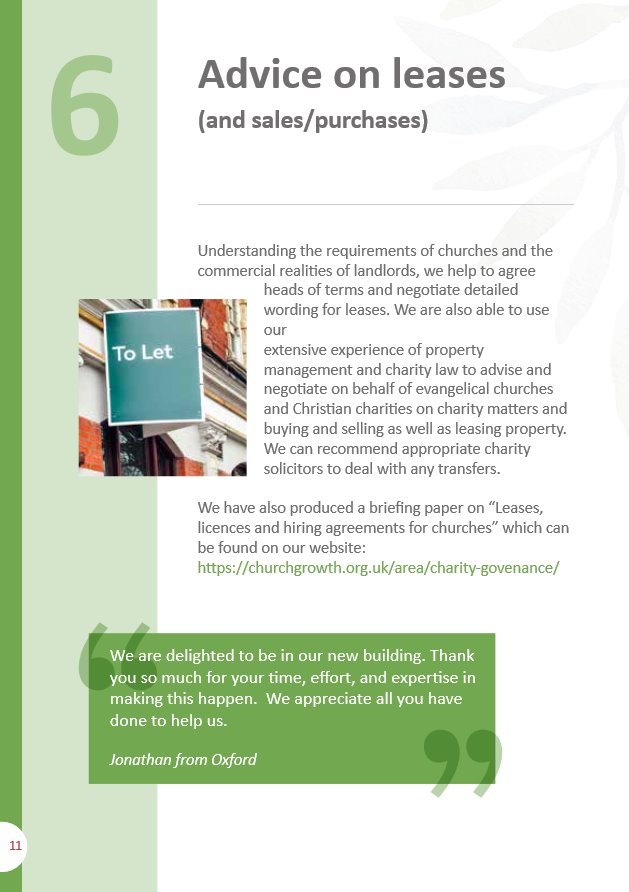
Church Growth Trust are delighted to announce the letting of the Yardley Wood Full Gospel Hall in Birmingham to Potters House Kings Heath. The building was recently transferred to the Trust when the fellowship stopped meeting at the hall.

After a marketing period of about four months a tenancy was discussed and agreed with the new church’s Pastor, Daniel Lettman. Daniel said, “We praise God that we have been able to agree a letting of the hall with Church Growth Trust. We are really excited as it will give us a permanent base from which to reach out to the local community with the Gospel and  show God’s love in genuine and tangible ways. We are looking forward to working with Church Growth Trust as our ministry grows.” John Duffield, Property Manager for Church Growth Trust said, “It is such an encouragement to see the baton of gospel proclamation pass from the hand of one group of believers to the next.

We pray God’s rich blessing on Pastor Daniel and his church as they step out in faith working with us to achieve our aim to declare the gospel from our buildings until Jesus returns.”

Sharing practical pointers – May 2020

Over the last few weeks we have had contact with a number of our churches and heard about how they have been coping with the impact of Coronavirus. In addition, a number of Christian organisations have been posting helpful and practical advice on their websites. There are links to some of these in our Tips of the Month for both April and May.

As one might expect, there are a number of common themes in these articles including the use of the internet for weekly services, prayer meetings, Bible studies and events for the church family. Three things have stood out for us as deserving of mention.

Firstly, seek out those members of your fellowship who do not have access to or feel able to use the internet to join in. These people will feel alone. It requires a special effort to include them. This may mean using “old school” pen and paper to send a card with a thoughtful message and comforting bible verse. Or perhaps give them a ring for a chat.

The second thing is making sure that safeguarding/DBS issues are considered when using the internet if it is going to involve interaction with young and vulnerable people. Proper protocols need to be followed to protect them before the event takes place.

Recent articles in the latest Together magazine from thirtyone:eight has helpful guidance for communicating and working with young people online and safeguarding during lockdown.

Thirdly, with regard to property, it is important to make sure your property is visited every week as insurers will normally expect this and such a visit will help any problems to be seen and dealt with early. In addition, when visiting it is a good idea to take meter readings of the utilities. Churches are telling us that cash flow is very important at the moment so it is better to pay bills based on actual meter readings presenting the true position rather than estimates.

To sign up to receive our regular email bulletin providing useful guidance for you and your church property please email enquiries@churchgrowth.org.uk.

Stay connected

We are exhorted in Hebrews 10:25 to: 

Not give up meeting together, as some are in the habit of doing, but encourage one another – and all the more as you see the Day approaching. 

The Coronavirus situation has meant that all churches in the UK have been unable to physically meet to encourage one another since the Prime Minister declared lockdown on Monday 23 March.  This is an almost unprecedented situation and the last time churches were unable to meet was between March 1208 and May 1213 when King John refused to accept Pope Innocent’s appointee, Stephen Langton as Archbishop of Canterbury.  Pope Innocent responded by placing England under an interdict, meaning that the clergy were prevented from celebrating the sacramentsi

The growing use of the internet has meant it has been possible for a number of years to “virtually” attend live streamed church services of many of the world’s larger churches via YouTube and social media. 

The recent Coronavirus crisis has meant that the UK churches have had to reconsider how they stay in touch and continue to communicate with each other and teach their congregations, when the opportunity to physically meet up has been removed for a season.  The use of smart phones and tablets has meant that staying in touch “virtually” is much easier than ever before, and although it cannot replace physically meeting together, it does mean that church congregations are able to maintain contact. 

Here are a few suggestions: 

WhatsApp is a useful way of setting up ‘groups’ to send messages, pictures, video links and typed prayers, and to keep in touch with each other.  You can use this platform for video phone calls with up to eight people at one time – www.whatsapp.com 

Messenger is a good way of connecting with a smaller group of people and you can use this platform for video phone calls with up to 50 people at one time, which may be a useful resource for smaller discipleship groups and prayer meetings – www.messenger.com 

Zoom is a video conference facility which allows larger groups (up to 100) to meet virtually at the same time and is a useful platform to use for house group type meetings, prayer meetings and church business meetings –  https://zoom.us/  

Many churches are recording a church service and then uploading this onto YouTube –https://www.youtube.com/?gl=GB&hl=en-GB  

The Evangelical Alliance has a dedicated page by Mark Crosby which contains many useful hints and tips for staying connected during this season and beyond – https://www.eauk.org/news-and-views/top-tips-for-doing-church-digitally 

Although this is a challenging season for many churches, it also presents an exciting step-change for churches to utilise the internet to reach members of the public, who might not ordinarily physically step inside a church building, with the Gospel; one example being Alpha, who have produced a digital format for churches to host Alpha completely online – https://www.alpha.org/alpha-online/.  

Also, there is the opportunity to provide additional platforms for church congregations to meet, pray and encourage one another easily during this time, which for many may continue to be a useful resource once the current lockdown situation has ended. 

Coronavirus – advice for churches

These are unusual times, but also times for us to be effective in our witness and to grow in our relationship with the Lord.  There are many places for you to obtain information that can help you during the Coronavirus shutdown.  We would like to share some of these with you.

Insurance Matters

Ansvar, one of the main church insurers, has issued a helpful update for churches insured by them.  This gives guidance on what to do now that physical meetings cannot take place in your church building.  It is practical and should answer most of your questions.  These include regular inspections, either draining down or keeping the heating on to stop pipes freezing and removing any perishable food stored in the property.  Click here [https://www.ansvar.co.uk/covid-19-updates/covid-19-news/] for more information.

Funerals

Weddings, baptisms and church meetings, large and small, are now not permitted.  Funerals are however allowed, but they may now only happen at the crematorium or at the graveside. Only members of the deceased person’s household or close family members should attend funerals. Any individual displaying symptoms of Covid-19 should not attend. Those who do attend will need to adhere to social distancing at all times, including when travelling to and from the funeral.  It is possible in many cases to use technology to capture the event for those who are unable to be there in person, either by recording it or by live streaming it to those remaining at home.  Government guidelines can be found here [https://www.gov.uk/government/news/new-advice-for-safe-funerals-after-discussions-with-faith-leaders].

Staying connected in this time of isolation

A great resource from Partnership [https://partnershipuk.org/covid19/] has been put together to help churches during the Coronavirus situation. Material includes practical tips to help local churches to continue their work and advice on pastoral care during lockdown.  Ranging from getting children to write letters to elderly members to planning your daily exercise to pass the window of church members in order to wave and smile as you pass.

Church Growth Trust’s new Property Administrator Elaine Roberts and CGT’s designer Tom Nicholson, who both lead in local Vineyard churches have come up with some practical ideas of using technology to keep connected.  This is an opportunity to discover new ways of connecting with each other and caring in practical ways for our church family and others in our community (fulfilling the royal law of James 2:8 by loving your neighbour as yourself).  It is also an opportunity to spend more time reconnecting with God and enjoying our closet time with Him.  See their thoughts in more details……[click here for article]

Evangelical Alliance

The Evangelical Alliance has set up a Coronavirus Hub on their website full of information just for churches.  Why not put a link on your church website, so all your members can have access?
[https://www.eauk.org/coronavirus?ref=top]

Financial issues

Stewardship has put together a financial guide [https://www.stewardship.org.uk/information/covid-page-2] for any questions that your church may currently be struggling with.  There is also on their website advice on using charity reserves and making decisions as trustees.

Legal matters

Anthony Collins solicitors have provided a briefing on some of the current legal issues [https://www.anthonycollins.com/media/3894/coronavirus-ebriefing-for-churches-updated-31-march.pdf]. If there is anything else Church Growth Trust can help you with, please do not hesitate to contact us on 01536 201339 or enquiries@churchgrowth.org.uk.

We are still here for you – April 2020

As we journey through these changing times, we want to assure you all of our commitment to support you where you are.

Even though we have had to closed our office, all staff are now working from home and can be contacted in the usual way, preferably by email but also by telephoning 01536 201339. If you have a direct number for any of the staff this can still be used.  If you want to be kept informed of the latest advice and relevant information for churches, please check our website for updates and/or sign up to our email bulletin by emailing enquiries@churchgrowth.org.uk.

We will do our utmost to maintain our high level of service during these times.

What do you do with your empty church building? – April 2020

Now that physical meetings cannot take place in your church building, consider a few things that you need to do.  Where you are able to do so safely and within the current government guidelines, we and insurers recommend that you do the following:

  • An authorised person should inspect your building internally and externally once a week to check the security and general condition of the premises.
  • Clear all waste, perishable food, refuse and other disused combustible materials from the building and any grounds adjacent to it.
  • Securely lock all external doors and close all opening windows (locking them where fitted with locking devices).
  • To prevent burst pipes from freezing (the nights are still very cold) and heating systems leaking, drain down all tanks and pipes and, when you are able to do this, turn off all taps, stopcocks and mains supply valves.  If this is not possible, because you need to maintain a central heating system, a minimum temperature of 7°C must be maintained.
  • Switch off gas supplies unless needed to maintain a central heating system.
  • Switch off electricity supplies unless needed to maintain a central heating system or existing intruder alarm systems, fire protection systems, CCTV, security lighting or sprinkler systems. 
  • Keep in full and effective operation at all times existing physical devices for securing, or preventing access to, the buildings and remove all keys from the locks, keeping them in a secure place away from the premises.

Whilst you may not be able to complete all of the items listed above, either partially or in their entirety, you are encouraged to consider anything you can do to reduce the risk of damage or loss, particularly through escaping water from heating systems and security of the premises generally.

It may also be useful to keep the church notice board (as well as your website) up to date with details of how the church is meeting virtually for services and small meetings, as well as providing contact numbers for people to call for prayer, to connect with the church, enquire about the Gospel and ask for other help.

Helping churches in practical ways – April 2020

Spellow Lane Church in Liverpool has recently been gifted to Church Growth Trust (CGT). When roofing contractors were repairing a leak in the valley gutter at the property, they noticed the capping stones on the gable end had moved and were in danger of pushing the large corbel stone off the building. This could not be seen from the ground, so it was providential that it was spotted when it was. Church Growth Trust were able to advise the church on the best options for making the roof safe and to do this in the most cost-effective way.

Although responsibility for repairs lies with the occupying church, CGT, with its property and architectural experience, is often able to give advice to churches to help them carry out work in the most practical and beneficial way. As John Duffield, CGT’s Property Manager, says: “We are keen for our occupying churches to talk to us at an early stage when work to the building is being considered, as we try to help them think through the best solutions and the wider issues around the work. It is all part of our positive approach to working with churches.”

Church Growth Trust’s Custodian Trusteeship Service in demand – March 2020

FIEC Limited, the trusteeship side of the Fellowship of Independent Evangelical Churches (FIEC), has recently changed its name to The Fellowship Property Trust. They act as holding trustee for a number of independent churches across the country. In many cases they are recommending to the churches that they speak to Church Growth Trust (CGT) to take over the holding trusteeship role. This is what CGT usually calls its custodian trusteeship service.

Where churches, which are unincorporated charities (constitutions or trusts), hold properties or where they are held by separate property trusts, individual (managing) trustees are named on the title at the Land Registry. This means that every time a new trustee is appointed, the title needs to be registered again in the new names. The custodian trusteeship role saves the managing trustees having to do this, as the title to the property is held by the custodian trustee, who is a trust corporation (i.e. in CGT’s case a charitable company). It means that the title does not have to be changed every time a managing trustee is appointed.

For only £100 plus VAT a year CGT not only offers the custodian trusteeship role, but storage of the property deeds (and online access given to the managing trustees) and signs up the church to Stewardship’s Consultancy Helpline. Giles Arnold, CGT’s Chief Executive, has been travelling around the country to meet different churches to talk about this custodian trusteeship role and, where appropriate, local churches are appointing CGT as their holding (custodian) trustee.

Saving chapels in the Welsh valleys for Gospel use – March 2020

There have been recent reports in the news of a retired evangelical congregational minister who has been buying chapels in the Welsh valleys that have been considered redundant and in some cases are semi-derelict. The Reverend Robert Stivey is passionate about restoring these places of worship and seeing them again used as vibrant centres of Gospel outreach to their local communities.

As Church Growth Trust share a similar passion for keeping church buildings in Gospel use and safeguarding them for the future, Giles Arnold, CGT’s Chief Executive, met with Robert Stivey and his son Dan to explore how CGT can help. As Giles Arnold states: “Robert and Dan Stivey have a major challenge ahead of them. Some of the chapels are huge with 1,000 seats, some are Listed and cannot be altered and others are in need of major repairs to make them usable. But our God is able! It is exciting to be working with them to help them in practical ways. Particularly as we share a similar vision.”

Church Growth Trust has advised on charity matters, particularly in terms of making sure that the properties are held for charitable purposes in the future. Giles Arnold has also been able to give a number of contacts of churches and organisations that are wanting to evangelise, plant churches and make use of buildings in South Wales. “It has been a privilege to help in a small way and we hope that we will be able to work more closely with Robert and Dan Stivey in the future. We are certainly praying for them to see the fulfilment of their vision and to see these amazing chapels being used again for Gospel work and to see transformation of the needy communities in which they are located.”

New CGT Trustee – March 2020

We are really excited to introduce our new trustee, Richard Jones to the Church Growth Trust team.

Richard is married and lives in West Derby, Liverpool and has two grown up daughters. He has been an active member of West Derby Evangelical Church since childhood. Serving as Elder and Trustee since 2002, Richard has been encouraged by the growth of the church, the faithfulness of its people and the positive work in the community. As a Chartered Quantity Surveyor, Richard has worked in the construction industry since 1989 delivering a range of consultancy services for public and voluntary sector organisations. A particular expertise is in education building consultancy for local authorities, dioceses and multi-academy trusts. Recently he has managed over £1bn of expenditure on schools for central government with global consultancy Arcadis. Richard also runs a small property rental business. Loving the outdoors, Richard enjoys travelling with the family, walking and long distance bicycle rides. 

We look forward to the valuable contribution Richard will bring to the direction of CGT.