Our vision and mission describe the aims of Church Growth Trust and the work we are committed to carrying out.
Our values and beliefs

Our vision
We aspire to glorify God by securing for Gospel use independent church properties and together with churches making them fit for their God-given purpose.
Our mission

We work alongside independent churches to help ensure their buildings continue to support worship, ministry and Gospel witness for generations to come.
We aim to fulfil our vision by:
- Holding and accepting independent church properties (as owner or trustee) and:
- Blessing churches which occupy our buildings by granting concessionary rents;
- Helping these churches to keep their properties in good condition, (where possible) energy efficient, compliant with legislation and suitable for modern church use, including helping to fund building projects;
- Providing professional property and architectural services and guidance in church practice and governance, including encouraging churches to make best use of their properties;
- Supporting church planting and revitalisation of independent churches.
What this means in practice
We carry out this work by:
- Holding church properties and letting them to evangelical churches
- Supporting churches who use our buildings
- Providing guidance and practical help
- Helping churches plan for the future
- Grant funding sister organisations who are directly involved in church planting
- Working with other organisations with the “Growing Churches – revitalisation project”.
Our values
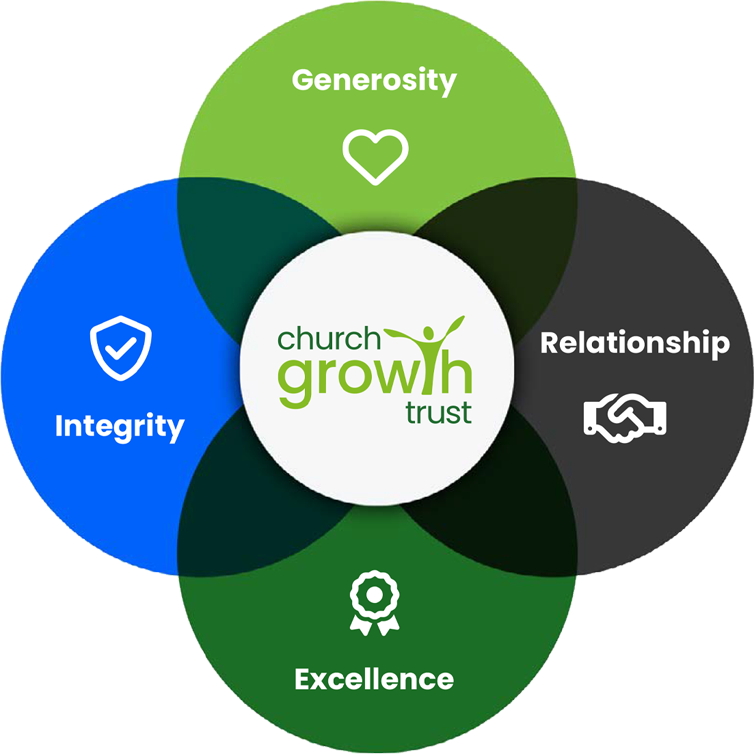
Our values shape how we work and how we seek to serve churches and one another. While we do not always get everything right, they guide our approach in practice.

Generosity
We aim to reflect God’s generosity in the way we work with others. We freely share our time, knowledge and experience, and seek to support churches and colleagues with openness, care and encouragement. Where we can, we go the extra mile.

Relationship
We believe relationships matter. We take time to listen, understand each situation and build trust. We seek to work well with churches, colleagues and partners as part of God’s wider Kingdom.

Excellence
We believe work that serves the Kingdom should be done well. We strive for high standards, continually improve where we can and take responsibility when things go wrong. We want our work to be practical, reliable and helpful.

Integrity
We aim to be honest, trustworthy and consistent in all that we do. What we say should reflect what we do. We take our responsibilities seriously and seek to act with integrity in both letter and spirit.
Our beliefs
Church Growth Trust is an evangelical Christian charity. Our work is shaped by the beliefs and doctrinal basis that underpin everything we do. They provide the foundation for how we care for church buildings and work with churches.
These beliefs are not simply statements of faith. They guide our decisions, shape our relationships and help ensure that church buildings continue to be used for Gospel ministry.
We believe and promote the following doctrines:
Church Growth Trust is an evangelical charity whose work is founded on the authority of Scripture and historic evangelical doctrine. The sections below summarise the biblical beliefs:
1. The Scriptures
The Scriptures – The Divine inspiration of the Bible and its consequent entire trustworthiness and supreme authority in all matters of faith and conduct.
(The Biblical injunction and model for marriage is a relationship given by God, reflecting the relationship between Jesus Christ and His Church for the good of mankind as laid down in Genesis 2:24, Mark 10:6-9, Ephesians 5:22-33, 1 Timothy 3:2 and elsewhere in the Bible and it is restricted to the union of one man and one woman who commit in love to one another to the exclusion of all others. CGT’s principle and policy on all matters in relation to gender is that God’s design was the creation of two distinct and complementary sexes, male and female (Genesis 1:27; Matthew 19:4; Mark 10:6) which designate the fundamental distinction that God has embedded in the very biology of the human race (Psalm 139:13-16), and God’s good design is that sex is determined biologically alone and it cannot be changed by any means.)
2. The Godhead
The Godhead – One God – the Father, Son and Holy Spirit – eternally existing in three distinct but equal persons. The sovereignty and grace of God the Father, God the Son, and God the Holy Spirit, in creation, providence, revelation, redemption, sanctification, and final judgement.
3. The Lord Jesus
The Lord Jesus – The Lord Jesus Christ, the incarnate Son of God was born of a virgin. His death on the cross and the shedding of His blood were substitutionary in character and constituted a propitiatory sacrifice. His death is the only ground of reconciliation and redemption from the guilt and power of sin and its eternal consequences. He was raised from the dead in bodily form and has ascended into heaven where he presides as head of the church and ministers as high priest for His people. His personal and visible return in power and glory will consummate the believer’s salvation and establish His glorious kingdom.
4. The Holy Spirit
The Holy Spirit – God the Holy Spirit illuminates the believer. He is responsible for the work of regeneration and sanctification. He indwells every believer and this begins at the time of conversion. He empowers for godly living and spiritual service. It is the responsibility of every believer to be filled with the Spirit.
5. Man
Man – Man was created sinless but through temptation by Satan became sinful and thereby brought the whole human race under the just condemnation of God and eternal separation from Him. Eternal salvation for mankind is through repentance and faith in the finished work of Christ. Justification is by grace alone.
6. The Church
The Church – The priesthood of all believers in the Lord Jesus who are members of the one, eternal and universal church, which is the body of which Christ is the head. The church is committed by the command of Christ to proclaim the Gospel throughout the whole world.
We would also support the following church practices:
- Each local church is composed of professed believers and is autonomous in government. It has as its model the New Testament practice of plurality of leaders equipped with appropriate spiritual gifts.
- There are two ordinances of the church, these being the baptism of believers by immersion on personal confession of faith in the Lord Jesus, and the remembrance of Him in the regular observance of the Lord’s Supper, in obedience to his command.
- The widespread distribution and exercise of spiritual gifts; regular meetings for worship, prayer, teaching and fellowship; outreach to the locality; and involvement in world mission.
Why this matters
Our beliefs shape:
- The type of ministry we support
- How church buildings are used
- The basis on which churches may occupy our properties
They help ensure that the buildings we hold continue to support Gospel ministry.

Questions about our values and beliefs?
If you would like to understand more about how our beliefs and values shape our work, we would be glad to talk with you.